Interesting case study using a number of cool data points that shows how WordPress has won the crown amongst Joomla and Drupal for being the most widely used CMS in the world. One things for sure, it certainly paid off for WordPress to be focused on making the democratization of content publishing as easy as possible first, then making WordPress incredibly extensible later. There is an entire laundry list of reasons of why WordPress is at the top of the mountain right now, the success of the platform can not be traced back to one thing. The comments in the article contain a couple of those reasons while the others are spread amongst the various comment and forum threads on the web.
The past 7-8 years is very interesting to look back upon to figure out how WordPress ended up in it’s current spot of being the best in breed within the content management space. But, what I find even more interesting is if whether or not the things that made WordPress successful in the past will continue to stick around so that the platform is equally or more successful in the future. Focus, ease of use, extensibility, etc. Be right back, I’m going to go ask my magic 8 ball. ∞
Migrating from Drupal to WordPress is one of the more difficult migration paths. There are scripts available to migrate from Drupal 6 to WordPress but the way in which those scripts were created only allow for the migration of a specific version of Drupal to a specific version of WordPress. Most of the time, these scripts are written and shared by people that couldn’t find an easy path to move from one to the other and generally give up on maintaining the script after completing their move. Instead of relying on outdated scripts, you may want to check out MigrateToWP.com. These folks specialize in moving sites from Drupal into WordPress. While that is their specialty, they’ll also move plain HTML, Joomla, Blogger and other CMS sites as well.
Judging by their pricing page, they seem rather reasonable for what you get, especially when you compare those prices to getting a developer to provide you with a custom migration script. What’s not offered through the Professional plan can be accomplished with plugins after the move is complete. If no predetermined planned suits your needs, you can get in touch with them and they will provide you a free estimate.
If you’ve used this service before feel free to share your experience.
This weeks edition of the show features a one hour presentation with the founders of Drupal and WordPress together on one stage to talk about Open Source. This presentation took place on October 6th through the 7th, 2011 at an event called Schipulcon which is a web marketing conference. Unfortunately due to audio problems, I had to cut out the first 5 minutes of the presentation so your ears don’t fall off. Special thanks goes out to Katie and the Schipulcon group for providing me this audio file as well as the permission to play it through the WordPress Weekly stream. The next live show is scheduled for Friday, October 28th at 9PM Eastern.
Here is the recorded video featuring the presentation of Matt Mullenweg of WordPress with Dries Buytaert of Drupal discussing open source. Kudos goes out to the Schipulcon group for getting these two together for an awesome presentation. The audio is terrible until you hit the 4 minute mark. If you want to see a transcript for some of the questions you can read them on the Schipul Blog. Definitely watch from 32 minutes onward as that is when the audience starts asking some pretty good questions.
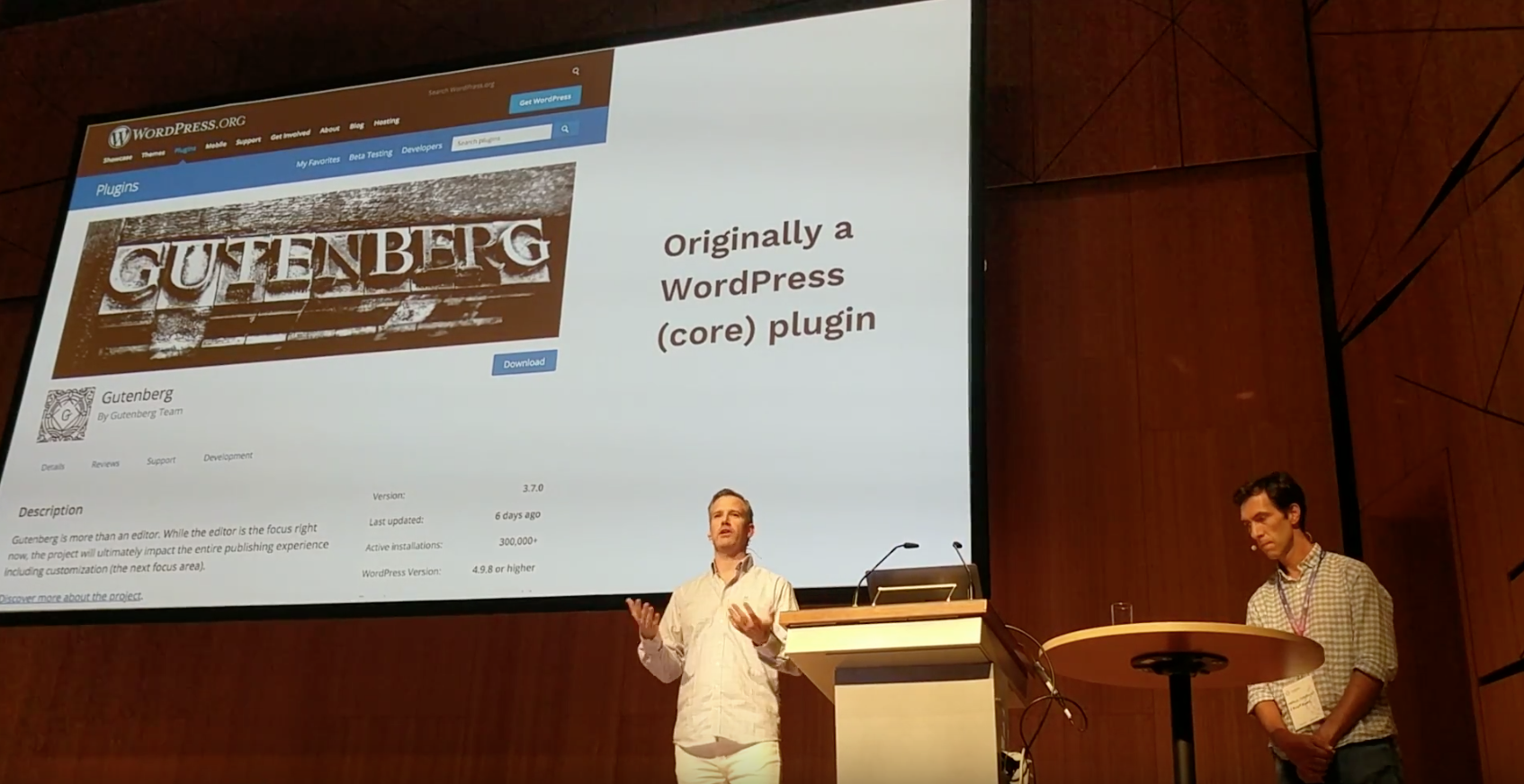
Here is something you don’t get to see all the time. WordPress co-founder Matt Mullenweg and Drupal founder Dries Buytaert shared the same stage at an event called Schipulcon. While catering to the web marketing crowd, the event also has a short but concise mission statement:
To grow community champions that make the world a better place through extraordinary thinking, smart technology and cross-industry creativity.
Schipulcon took place in Houston, Texas which is the hometown of Matt Mullenweg. While some expected the two founders to duke it out, according to some in the audience, it looked more like a bromance.
Dries Buytaert and Matt Mullenweg at SchipulCon 2011 by Ed Schipul
Video for this session if not currently available but the folks who ran the event have said that the video will be published soon. However, there were a couple of notable quotes that were shared over twitter. Here is just a sampling.
kamichat
Wordpress founder @photomatt says the next gen for Wordpess is more social and mobile. #schipulcon – via
Beccamus
Cool! Some of the best tech & creative opportunities developed in #Houston like wordpress by @photomatt #schipulcon – via
Janerri
Though biased, I’m enjoying the contrast & comparison of @Drupal @WordPress It’s friendly now, how long will that last? #schipulcon – via
AshleyRSmall
Our architecture is our greatest advantage over WordPress – @dries #schipulcon – via
thisisnotapril
“If WordPress wins; Drupal wins. Because it means open source wins.” -@Dries #schipulcon – via
qcait
Wordpress @photomatt’s Drupal developer profile is #5665, created 8 yrs ago. Profile lists “simplicity” as an interest. #schipulcon – via
I for one am seriously looking forward to watching the video of this session once it’s released.
Additional photos of Matt Mullenweg and Dries Buytaert can be found within this photoset.
Meg Heckman of Poynter.org shares her experience from a newsroom perspective with The Monitor using Drupal while sharing the experience of William Davis of the Daily News and their move to WordPress.
So which system is better?
Neither.
The question of WordPress versus Drupal isn’t Coke/Pepsi, boxers/briefs, Red Sox/Yankees. It’s about understanding the needs of your organization.
The five questions brought up within the post are definitely ones you should have answers to before making any decision to go with a particular platform. As a bonus, check out the comment left by pmaiorana who claims to work for Automattic with regards to the important factor of software updates.
WordPress has a smaller community than either Drupal or Joomla, so you may not find be able to find the help you need. – Not sure who could agree with that statement, especially after reading this report which is about a year old but most likely, still relevant. Regardless of the report, I’d love to hear anyone back up the claim that WordPress has the smallest community amongst the two. ∞
BuiltWith Trends is an analytics company that provides weekly updated free information about the most popular technologies used on the web such as advertising, frameworks, ecommerce and content management systems. Their CMS page lists the distribution of popular CMS solutions across the top million, top one-hundred thousand, and top ten-thousand websites. It should be no surprise that WordPress takes the majority of the pie in each section but amongst the three different categories, there is something that I find interesting. For instance, amongst the top 100,000 websites, Vbulletin has a 3.42% share while amongst the top 10,000 websites, it has a 9.35% share. Amongst the top one million sites, Drupal has a share of 2.82% but within the top 10,000 websites, has a share of 23.33%.
These numbers change on a weekly basis as their stats update but what this shows me is that there could be a lot of people using a particular CMS but that doesn’t necessarily translate into those sites having high traffic. I’m pretty impressed to see that WordPress powers practically half of the top 10,000 websites recorded by BuiltWith Trends. It’s also worthy of noting that Drupal commands just about a quarter of those sites showcasing that systems ability to handle massive websites.
In a interesting business move by WooThemes, the commercial theme company has announced that they will be re-focusing their efforts to be a WordPress centric theme company, again. Another example as to how time flies, it wasn’t too long ago when WooThemes began releasing themes for Expression Engine, Tumblr, Drupal, Joomla, and Magento. This was a move to diversify their business and expand into different markets but after a year into the experiment, it turns out that there is more to it than cranking out themes.
We have no knowledge of these platforms, which meant we had to partner with collaborative developers to help us expand onto these other CMS’s. We luckily found brilliant partners passionate and committed to their niche CMS strengths. Collaborations have their own little intricacies and our experience with these platforms & development processes was just never the same, as it was with WP.
We realized that we had no knowledge of these communities, which meant that it was hard for ourselves to get a firm foothold there. Our roots are firmly in the WP community and as a result we always tried to replicate our WP ideas in these other communities, but we eventually realized that we had to tailor our approaches accordingly. The decision to focus our attention on WP instead is simply due to team capacity, budgets & priorities.
In our hearts, and without trying to step on anyone’s feet, we could never get as excited about a new Drupal or EE theme in the same way we do before every WP release. Passion is always important.
It’s great to see that WooThemes is taking measures to ensure that their non WordPress platform customers will be taken care of by the end of April. So is it a risky move by WooThemes to reorganize into a one platform theme company again? Of course, but it’s not like WordPress is going any where and it doesn’t seem to be crumbling down anytime soon. How long WordPress continues to be king of the hill remains to be seen but I’d venture to guess it will be at least a couple more years. Hopefully longer.